Human Rights in Finance (.EU), known as HRIF.eu, has in June 2025, just prior to the lauch of the DR-trading facility on Euronext, formally requested enforcement action from the Dutch financial regulator AFM and trading platform Euronext, urging them to intervene in the Triodos Bank case. The request centers on serious omissions and misleading information in Triodos’ 2025 prospectus (see article here), which was used to facilitate the listing of its depository receipts (DRs) on Euronext,
Despite clear evidence — in particular the risk management section of a 2019 supervisory decision from the Dutch Central Bank (DNB) — both AFM and Euronext have refused to act and are now attempting to brush aside the request and deny HRIF legal standing. As a result, HRIF.EU is escalating the matter to the Dutch administrative court, seeking a formal review of the regulator’s conduct and Triodos’ disclosures.
What facts are still missing in Triodos court cases (also in the Netherlands):
Our legal action has been in preparation for over two years, beginning immediately after the DNB’s decision on Triodos’ risk management failures became known. That decree, kept silent from the public and judiciary, contained this observation, which is quite relevant:
“From the interviews that DNB conducted during the investigation with employees of Triodos NL, it emerges that the Integrity Risk Analysis was subsequently shared for informational purposes with the board of Triodos and presented to the management of Triodos NL. The board of Triodos and the management of Triodos NL were not visibly substantively involved in the preparation of the Integrity Risk Analysis. This implies, among other things, that the Integrity Risk Analysis was insufficiently aligned with the business strategy and the risk appetite formulated by Triodos.”
In essence this says: Triodos management was not actively involved in the risk management process. They treated the staff-presentation/content of the analysis as for information instead of the risk management tool it needs to be to consider and weigh risk decisions and mitigating measures. This is a pretty serious governance failure for a bank and we cannot remember having seen such harsh wordings ever.
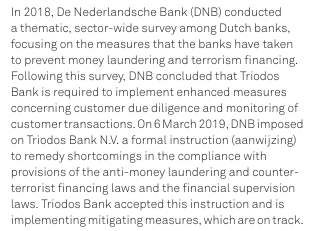
Afterwards Triodos adapted risk management and governance procedures but kept on insisting in all kinds of publications and press that this had nothing to do with DNB’s supervisor actions. They tried to frame DNB’s interventions as focused on solely AML/KYC stuff, but such a SIRA-analysis is far wider. See the quote here:
HRIF.EU observed that even in Dutch court cases, Triodos Bank has not actively offered the content of this DNB supervision to the court. So the question of possible mismanagement was undecided whilst the DNB-observation could have clearly made the difference here.
What eventually happened is that the DNB-decision was published late in time, almost silently, hoping no one would notice. But we did, because our main focus is also venture in the risk/compliance domains that are very specialised to this matter. That is also how we succeeded in bringing down the Dutch, nation-wide, illegal banking dragnet.
EU cross-border impact — over 1 million DRs possibly still held abroad and holders not aware of the Dutch HRIF case
As of August 2025, Triodos’ €10 settlement offer has been accepted for 11.4 million out of 14.2 million DRs, leaving 2.8 million DRs outside the settlement. HRIF.eu estimates that over 1 million of these may be held by foreign investors, particularly in Spain, Germany, Belgium, and the UK.
This makes the case not just a Dutch affair, but a pan-European financial and human rights issue — precisely why HRIF operates under a .eu domain. The AFM’s failure to act has cross-border consequences, undermining investor protection across the EU.
So what do I have to do now as a DR holder that feels the injustice of Triodos actions?
Well, not much, other than perhaps going to the Dutch page of this article and finding our source documents in Dutch. You can provide them to your lawyers, translate them yourself and try and understand what we are doing. Because the most important thing is: as foreigners you are currenly missing out on essential parts of the Triodos debate and the (unlawful) lack of action of AFM as a supervisor to ensure transparency and proper customer information provision to DR holders.
So, if you value you the work we do, you can see an IBAN on our webpage and send some funds. You can send us an e-mail with warm support, that is also nice. And if you truly wish to be involved legally, you can also join the formal objection-procedure against AFM, as part of your legal strategy. Our power of attorney (see on the Dutch page) does not pertain to the civil law proceedings, it is purely the Dutch administrative law stuff. It can be revoked anytime and we don’t charge fees.
What’s in it for us?
We are in it for the core principe that Triodos bank is and was not allowed to intrude on your human right (to ownership) in such a manner as they did and the AFM should have been there to protect you from that (in their role as a supervisor). And whether it’s a banking dragnet, discrimination, denial of bank services, protection of the use of cash and bank accounts: whenever human rights are infringed in economic transaction processes with complex supervisory legislation, we jump in to go where other NGO’s are unable to go, due to the jungle-nature of EU-financial legislation.
And for more information on our foundation, have a look at the About Us section.